Building USoC Part 2: The Fabric
In Part 1, we broke down the standard Wishbone interface and established the formal rules required to guarantee its correctness. Now, it’s time to stitch everything together into a functional system.
Because we are on a tight timeline—next week we are diving straight into PHYs, the PIPE interface, and building a UART—we need to assemble our core System-on-Chip (SoC) fabric cleanly, elegantly, and without wasting any time on unnecessary architectural bloat.
Decoders vs. Arbiters: The Multi-Master Problem
To understand how our interconnect works, we need to quickly contrast two fundamental building blocks:
- Decoder: Logic that allows a single master to talk to multiple slaves by routing signals based on an address map.
- Arbiter: Logic that allows multiple masters to talk to a single slave by deciding who gets access to the bus.
A traditional on-chip bus combines both arbiters and decoders. However, arbitration is time-multiplexed by nature: only one master can occupy the bus at any given moment, creating an engineering bottleneck.
So why do we even want multiple masters? If a CPU has to manually read every word from a high-speed Ethernet or USB peripheral and copy it into memory line by line, it wastes massive amounts of processing cycles. This is why the Direct Memory Access (DMA) engine was invented. A DMA is a peripheral that acts as a slave when the CPU configures its control registers, but morphs into a bus master to copy packets directly to and from memory independently.
In our USYS architecture, we took a radical approach: every single device uses a DMA.
Our core peripheral DMA is called UBUS. By pairing UBUS with our single RISC-V core, our entire SoC contains exactly two bus masters. Because we restricted our design to exactly two masters, we can bypass traditional bus arbiters entirely. Instead, we route traffic through a standard dual-ported SRAM module. Dual-port SRAM naturally allows for concurrent reads and writes from two separate masters simultaneously, as long as they aren’t writing to the exact same memory address.
Implementing the Wishbone Decoder
While we don’t need an arbiter, our masters still require a decoder to route transactions to the correct memory addresses or peripherals.
First, we determine which slave the master is targeting by evaluating the address lines:
slave0_match = (master.addr >= self.slave0_addr) & (master.addr < (self.slave0_addr + self.slave0_size))
If a match is found, we subtract the base address offset and dynamically bridge the master and slave lines.
But what happens if a master attempts to access an invalid address? In hardware design, a bad address can cause an infinite stall, hanging the bus forever. To solve this, our decoder catches invalid addresses, manually asserts an acknowledgment signal (ack) to gracefully terminate the broken transaction, and raises a bus_error flag directly to the CPU.
Here is how the decoder looks in Amaranth HDL:
outstanding = Signal(8)
active_slave = Signal(2)
req_issued = master.cyc & master.stb & ~master.stall
res_rcvd   = master.cyc & master.ack

with m.If(master.cyc):
    m.d.sync += outstanding.eq(outstanding + req_issued - res_rcvd)

    # Route to Slave 0
    with m.If(slave0_match & ((active_slave == 1) | (active_slave == 0))):
        m.d.sync += active_slave.eq(1)
        m.d.comb += [
            slave0.cyc.eq(master.cyc),
            slave0.stb.eq(master.stb),
            slave0.we.eq(master.we),
            slave0.addr.eq(master.addr[:slave0_bits]),
            slave0.sel.eq(master.sel),
            slave0.dat_w.eq(master.dat_w),
            master.dat_r.eq(slave0.dat_r),
            master.ack.eq(slave0.ack),
            master.stall.eq(slave0.stall),
        ]

    # Route to Slave 1
    with m.Elif(slave1_match & ((active_slave == 2) | (active_slave == 0))):
        # ... Mapping logic for slave 1 goes here ...

    # Handle Invalid Addresses (Deadlock Prevention)
    with m.Else():
        m.d.sync += active_slave.eq(3)
        m.d.comb += [
            master.ack.eq(outstanding > 0),
            bus_error.eq(1),
        ]
with m.Else():
    m.d.sync += outstanding.eq(0)
    m.d.sync += active_slave.eq(0)
The Dual-Port SRAM Module
With our decoder ready, we need an SRAM block to store data and instructions. To hit our target performance metrics on low-cost FPGAs, we need the hardware synthesis tools (like Yosys) to automatically infer hardware block RAM (BRAM) rather than constructing memory out of thousands of power-hungry LUTs.
To guarantee block RAM inference, our memory architecture relies on a predictable, synchronous design featuring strict two-cycle read and write pipelines, paired with byte-lane selection (sel) masks.
Here is the core block configuration for Port A of our dual-port SRAM:
# Instantiate the raw synchronous memory core
mem = m.submodules.ram_core = memory.Memory(shape=32, depth=self.depth, init=[])

# Define our synchronous read and write ports
mem_r_a = mem.read_port(domain='sync')
mem_w_a = mem.write_port(domain='sync', granularity=8)

ack_a = Signal()
x_ack_a = Signal()

# Combinational port steering
m.d.comb += [
    port_a.stall.eq(0), # SRAM port never stalls the master
    port_a.ack.eq(port_a.cyc & ack_a),
    port_a.dat_r.eq(mem_r_a.data),
    mem_w_a.addr.eq(port_a.addr),
    mem_r_a.addr.eq(port_a.addr),
    mem_w_a.data.eq(port_a.dat_w),

    # Conditional Byte-lane Selection for Writes
    mem_w_a.en.eq(Mux(port_a.cyc & port_a.stb & port_a.we, port_a.sel, 0)),
    mem_r_a.en.eq(port_a.cyc & port_a.stb & ~port_a.we),
]

# Register-tracked two-cycle acknowledgment pipeline
m.d.sync += [
    ack_a.eq(port_a.cyc & x_ack_a),
    x_ack_a.eq(port_a.cyc & port_a.stb),
]
The Final Assembly
We now have all our ingredients: Wishbone interfaces, decoders, and a dual-port synchronous memory module. We can wire them together into our final system fabric module: UsysFabric (the blue section).
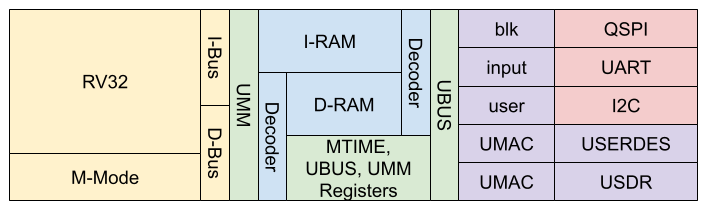
By laying out clean address spaces for Instruction SRAM (I_SRAM), Data SRAM (D_SRAM), and Memory-Mapped I/O (MMIO), our two masters (cpu and ubus) can execute concurrent operations seamlessly across the dual-port memory boundaries.
class UsysFabric(wiring.Component):
    def __init__(self):
        super().__init__(wiring.Signature({
            "cpu_ibus":      In(wb_sig),
            "cpu_dbus":      In(wb_sig),
            "ubus_master":   In(wb_sig),
            "ubus_slave":    Out(wb_sig),
            "cpu_bus_error": Out(1)
        }))

    def elaborate(self, platform):
        m = Module()

        # Define our absolute base address mappings
        I_SRAM_ADDR = 0x10000000
        D_SRAM_ADDR = 0x20000000
        MMIO_ADDR   = 0x30000000

        # Submodule Instantations
        m.submodules.i_sram = i_sram = WishboneDualPortSram(depth=self.depth_i)
        m.submodules.d_sram = d_sram = WishboneDualPortSram(depth=self.depth_d)

        m.submodules.dbus_decoder = dbus_decoder = WishboneDecoder(
            slave0_addr=D_SRAM_ADDR, slave0_size=self.depth_d,
            slave1_addr=MMIO_ADDR,   slave1_size=self.depth_mmio,
        )
        m.submodules.ubus_decoder = ubus_decoder = WishboneDecoder(
            slave0_addr=I_SRAM_ADDR, slave0_size=self.depth_i,
            slave1_addr=D_SRAM_ADDR, slave1_size=self.depth_d,
        )

        # Interconnect Wiring Matrix
        wiring.connect(m, i_sram.port_a, wiring.flipped(self.cpu_ibus))
        wiring.connect(m, dbus_decoder.master, wiring.flipped(self.cpu_dbus))
        wiring.connect(m, ubus_decoder.master, wiring.flipped(self.ubus_master))
        wiring.connect(m, d_sram.port_a, dbus_decoder.slave0)
        wiring.connect(m, wiring.flipped(self.ubus_slave), dbus_decoder.slave1)
        wiring.connect(m, i_sram.port_b, ubus_decoder.slave0)
        wiring.connect(m, d_sram.port_b, ubus_decoder.slave1)

        # Route decoder exceptions directly back to the processor core
        m.d.comb += self.cpu_bus_error.eq(dbus_decoder.bus_error)

        return m
With our structural fabric fully assembled and verified, our internal parallel pathways are locked in place. Next week, we take a massive step forward: crossing from internal silicon logic into the physical outside world. We will look at implementing the PHY PIPE interface and using it to build a hardware UART from scratch. Stay tuned!